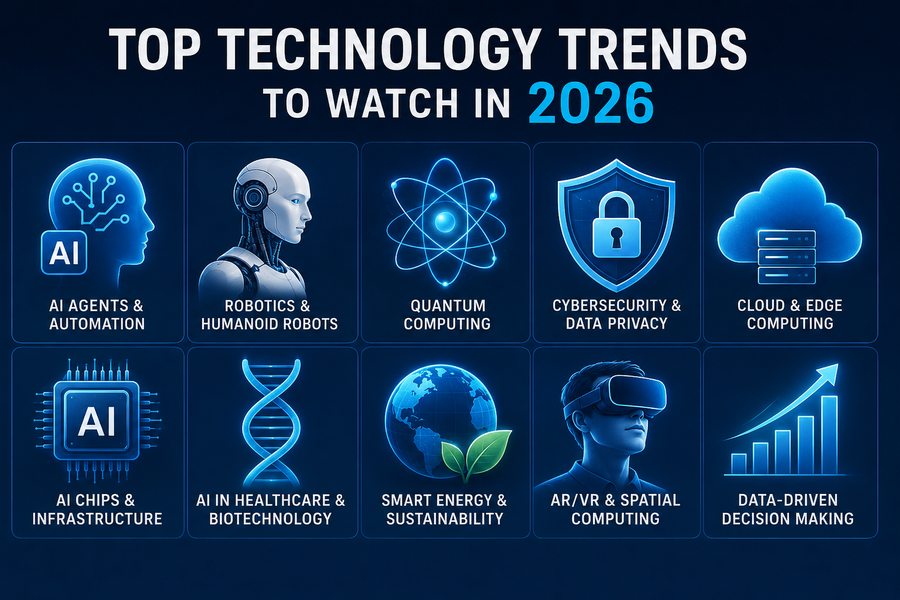
The top technology trends to watch in 2026 are not simply a list of new gadgets or fashionable software features. They represent a broader shift toward systems that can reason, act, learn, operate closer to the physical world, and make decisions with increasingly little human intervention.
Why 2026 Is a Turning Point for Technology
The technology industry entered 2026 with an important realization: building powerful models is only one part of the transformation. The next challenge is turning those models into reliable systems that can perform useful work. This is why discussions around AI agents, physical AI, AI-native development, robotics, AI infrastructure, cybersecurity, and autonomous systems have become increasingly important.
Businesses have largely moved beyond asking whether AI matters. They are now asking where it can create measurable value. The answer increasingly involves systems that connect models with company data, software tools, workflows, sensors, machines, and decision-making processes.
AI Moves From Assistance to Action
For years, most consumer AI tools operated like sophisticated assistants. You asked a question, requested an image, summarized a document, or generated some code, and the system returned an answer. In 2026, the more interesting direction is action-oriented AI.
Instead of simply telling you how to perform a task, an AI system can increasingly participate in the task itself. An agent might analyze information, choose a sequence of actions, use software tools, check the results, adjust its approach, and continue until it reaches a defined objective.
The Rise of AI Agents
An AI agent can be thought of as the difference between a knowledgeable assistant and a digital employee. A conventional chatbot might tell you which steps to follow when processing an invoice. An agent could potentially retrieve the invoice, extract the information, compare it against company records, identify discrepancies, update an accounting system, and flag unusual transactions for human review.
The distinction is important. Generative AI primarily produces content, while agentic AI is designed around goals, actions, tools, and feedback loops. AI agents are expected to become increasingly relevant to business workflows throughout 2026.
Where AI Agents Could Have the Biggest Impact
AI agents are particularly interesting in environments involving repetitive digital workflows. Customer support, software development, IT operations, research, sales operations, finance, document processing, scheduling, and data analysis are natural candidates because much of the work already occurs inside digital systems.
The biggest opportunity may not come from replacing an entire profession. Instead, organizations may gradually redesign individual workflows around AI. A human employee might supervise several specialized agents, verify important decisions, and handle unusual cases while the agents perform routine operations continuously.
AI-Native Software Development
Software development is undergoing a major transformation. AI coding tools have moved beyond simple autocomplete systems toward systems capable of understanding repositories, generating code, finding bugs, writing tests, explaining unfamiliar code, and helping developers solve complicated implementation problems.
This does not mean developers are becoming unnecessary. Software engineering involves architecture, requirements, security, product decisions, infrastructure, debugging, and accountability. Instead, developers are likely to spend more time directing systems, reviewing outputs, designing architectures, and solving problems that require judgment.
Multi-Agent Systems and Specialized AI
One major direction is the development of multi-agent systems, where several specialized AI systems cooperate. One agent might research a problem, another could write code, another could test it, and another could review security risks. A coordinating system can assign tasks and combine their results.
Specialization may also become increasingly important. A general-purpose model can be useful across many subjects, but organizations often need systems designed for specific industries and workflows. Financial institutions, healthcare organizations, manufacturers, and technology companies can all benefit from specialized AI systems.
Physical AI and Humanoid Robotics
AI is no longer confined to screens. Physical AI is bringing machine intelligence into robots, drones, vehicles, factories, warehouses, laboratories, and other physical environments.
The basic idea is straightforward: combine perception, reasoning, planning, and physical action. A robot must not only understand what an object is; it needs to determine how to approach it, how much force to apply, what could go wrong, and what to do next.
Smarter Robots in Industry and Everyday Life
Industrial robots have existed for decades, but newer systems are becoming more flexible. Traditional automation often performs the same movement repeatedly under tightly controlled conditions. AI-powered robots are being developed to operate in environments that are less predictable.
Humanoid robots are attracting particular attention because their physical form can potentially allow them to operate in environments designed for humans. Manufacturing, logistics, inspection, healthcare, and other industries could become important early markets for increasingly capable robots.
AI Supercomputing and Next-Generation Chips
Behind almost every major AI development is enormous computing infrastructure. Training and running advanced models requires specialized processors, high-speed networking, memory, storage, cooling, and large-scale data centers.
This makes AI computing infrastructure one of the most strategically important technology trends of 2026. The hardware race is evolving beyond traditional CPUs toward GPUs, AI accelerators, custom silicon, advanced packaging, high-bandwidth memory, and specialized networking technologies.
Edge AI and On-Device Intelligence
Not every AI task needs to send data to a remote cloud server. Edge AI moves computation closer to the user or device. Phones, cameras, vehicles, industrial machines, medical devices, laptops, and IoT equipment can increasingly process information locally.
Local processing can reduce latency, improve privacy, and make applications more resilient when internet connectivity is limited. As smaller and more capable models become available, expect more AI workloads to move toward a hybrid cloud-edge architecture.
Quantum Computing Enters a More Practical Phase
Quantum computing remains one of the most fascinating long-term technology trends. Unlike classical computers, quantum computers use quantum mechanical properties to process information in fundamentally different ways.
The important word for 2026 is progress, not mass adoption. Quantum computers are still difficult to build and operate, and many commercial applications remain experimental. However, governments, universities, telecommunications companies, and technology companies continue investing in the field.
Post-Quantum Cybersecurity
Quantum computing creates another major technology trend: post-quantum cryptography. Today's encryption systems protect enormous amounts of digital information, but sufficiently powerful quantum computers could eventually threaten some widely used cryptographic methods.
Organizations therefore need to think about migration before large-scale quantum computers arrive. Security teams should understand where cryptography is being used and identify systems that may require future upgrades.
Confidential Computing and Privacy-Preserving AI
AI creates a difficult privacy problem: organizations want to use sensitive information to obtain better results without exposing that information unnecessarily. Confidential computing addresses part of this challenge by protecting data while it is being processed.
This becomes increasingly important as businesses use AI with financial records, customer information, intellectual property, medical data, and internal documents. Privacy-preserving technologies can help organizations increase AI adoption while maintaining stronger controls around sensitive information.
AI-Powered Cybersecurity
Cybersecurity is entering an arms race where attackers and defenders both use AI. Attackers can potentially automate phishing, reconnaissance, social engineering, vulnerability discovery, and content generation.
Defenders can use AI to analyze enormous volumes of logs, identify suspicious patterns, prioritize alerts, investigate incidents, and respond faster. Organizations still need strong identity controls, access management, monitoring, software supply-chain security, employee awareness, and incident response.
AI in Healthcare and Biotechnology
Healthcare may become one of the most consequential application areas for AI. Modern systems can analyze medical images, summarize clinical information, assist researchers, support drug discovery, and help scientists identify patterns across enormous datasets.
The next stage is likely to involve deeper integration between AI, biotechnology, robotics, and laboratory automation. AI can help researchers evaluate possibilities more quickly, while robotic systems can perform repetitive laboratory tasks.
Autonomous Laboratories and AI Scientists
The concept of an autonomous laboratory connects several emerging technologies. AI can analyze scientific literature, robotics can perform physical procedures, simulation software can model potential outcomes, and machine learning can identify promising candidates.
An autonomous research system could potentially begin with a scientific question, propose hypotheses, design experiments, use robotic equipment to conduct them, analyze the results, and refine its next experiment. This could increase the speed at which researchers test ideas while maintaining human oversight.
Smart Energy, AI-Driven Grids, and New Power Technologies
AI has an enormous appetite for electricity, which means energy technology has become inseparable from the AI discussion. Data centers require substantial power, making energy availability an increasingly important infrastructure issue.
At the same time, AI can help forecast electricity demand, balance renewable energy, optimize storage, detect equipment problems, and coordinate distributed energy resources. This creates an interesting feedback loop: AI requires more energy, while AI can also help energy systems operate more efficiently.
Spatial Computing, AR, and Immersive Interfaces
Spatial computing combines digital information with physical environments. Augmented reality, mixed reality, computer vision, 3D interfaces, and wearable devices all contribute to this broader technology category.
Potential applications include industrial maintenance, engineering visualization, training, healthcare, education, remote collaboration, and design. A technician could see instructions overlaid on equipment, while an architect could examine a three-dimensional building model at full scale.
Technology Convergence Will Define the Next Era
Perhaps the biggest technology trend of 2026 is not a single technology at all. It is convergence. AI becomes more powerful when combined with robotics. Robotics becomes more capable when combined with edge computing. Quantum computing becomes more useful when combined with classical supercomputing and AI.
Consider a modern smart factory. AI models analyze production data, edge computers make real-time decisions, robots perform physical tasks, digital twins simulate changes, cybersecurity systems monitor the environment, and cloud infrastructure coordinates the entire operation.
What These Trends Mean for Businesses and Workers
Technology changes the tools people use, but it also changes what organizations expect from employees. As routine digital tasks become increasingly automated, human skills such as critical thinking, communication, problem-solving, creativity, judgment, and adaptability become increasingly valuable.
The shift is already visible across many industries. A marketer may use AI to research and draft campaigns while remaining responsible for strategy. A programmer may spend less time writing repetitive code and more time reviewing architecture and AI-generated implementations.
How to Prepare for the Technology Trends of 2026
Businesses do not need to adopt every technology appearing in the news. Trying to chase every trend is one of the fastest ways to waste money. A better strategy is to start with business problems and then identify technologies capable of solving those problems.
For AI, establish clear governance and testing procedures. For cybersecurity, strengthen identity, monitoring, and incident response. For cloud infrastructure, pay attention to cost and performance. For employees, invest in practical AI literacy rather than simply purchasing another software subscription.
- Build practical AI and automation skills.
- Understand cybersecurity fundamentals.
- Develop data literacy.
- Learn how to evaluate AI-generated information.
- Follow developments in your specific industry.
- Focus on skills that combine technology with human judgment.
Conclusion
The top technology trends in 2026 reveal a common direction: technology is becoming more autonomous, connected, intelligent, and deeply integrated into the physical and economic world. AI agents are moving from conversation toward action, robotics is gaining intelligence, AI infrastructure is expanding, edge computing is bringing intelligence closer to devices, and cybersecurity is adapting to increasingly sophisticated threats.
Quantum computing and post-quantum cryptography represent a longer-term transformation, while AI-powered healthcare, autonomous laboratories, smart energy systems, and spatial computing demonstrate how digital intelligence can influence industries far beyond traditional software.
The most important lesson is that no single technology will define the future by itself. The real transformation will come from convergence—AI working with chips, cloud systems, robots, sensors, biotechnology, cybersecurity, energy infrastructure, and human expertise.
Frequently Asked Questions
1. What is the biggest technology trend in 2026?
Artificial intelligence remains one of the biggest technology trends in 2026, particularly the development of agentic AI systems that can perform multi-step tasks and interact with software tools.
2. Will AI agents replace human workers in 2026?
AI agents are more likely to automate specific tasks and change job responsibilities than completely replace entire occupations in 2026. Human judgment, creativity, accountability, and domain expertise will continue to matter.
3. Is quantum computing ready for mainstream use?
Quantum computing is still an emerging technology. Commercial experimentation is increasing, but widespread mainstream adoption has not yet occurred.
4. Why are humanoid robots becoming important in 2026?
Advances in artificial intelligence, computer vision, sensors, simulation, and robotics are making humanoid robots increasingly capable of performing useful tasks in controlled environments.
5. What technology skills should people learn in 2026?
Useful skills include AI literacy, data analysis, cybersecurity, automation, cloud computing, software development, critical thinking, and domain-specific expertise.

- Small Business Finance: Manage Money & Grow Your Business
-
 Health - 02:52:34pm 30-09-2026

- Business Finance Strategies Every Entrepreneur Should Know
-
Health - 02:44:54pm 30-09-2026
-
 Universal
Should I Hire a Lawyer for a Minor Car Accident A Complete Guide to Protecting Your Rights
Universal
Should I Hire a Lawyer for a Minor Car Accident A Complete Guide to Protecting Your Rights
-
 Universal
History of Tangail Zilla in Bangladesh: Ancient Past, British Era, Zamindar Heritage, and Modern Development
Universal
History of Tangail Zilla in Bangladesh: Ancient Past, British Era, Zamindar Heritage, and Modern Development
-
 Universal
The Coverage Included in an Automobile Insurance Policy Weegy A Complete Guide for Drivers
Universal
The Coverage Included in an Automobile Insurance Policy Weegy A Complete Guide for Drivers
-
Business finance
Small Business Finance: Manage Money & Grow Your Business
-
 Technology
Top Technology Trends to Watch in 2026
Technology
Top Technology Trends to Watch in 2026