-
News
Universal
In a Car Insurance Policy, Collision Insurance Covers – Complete Guide Weegy Explained
- Admin
In simple terms, collision insurance covers damage to your own vehicle resulting from a collision with another vehicle or object, regardless of who is at fault. But what exactly does that mean in real life? How does it differ from liability or comprehensive coverage? Is it worth buying? And when does it pay out?
This comprehensive, SEO-optimized guide explains everything you need to know about collision coverage in auto insurance — from what it includes to what it excludes, costs, deductibles, and real-life claim examples.
What Is Collision Insurance?
Collision insurance is a type of auto insurance coverage that pays for repairs or replacement of your vehicle if it is damaged in a collision.
Unlike liability insurance, which pays for the other person’s damages, collision insurance protects your car.
Simple Definition (Weegy-Style Answer)
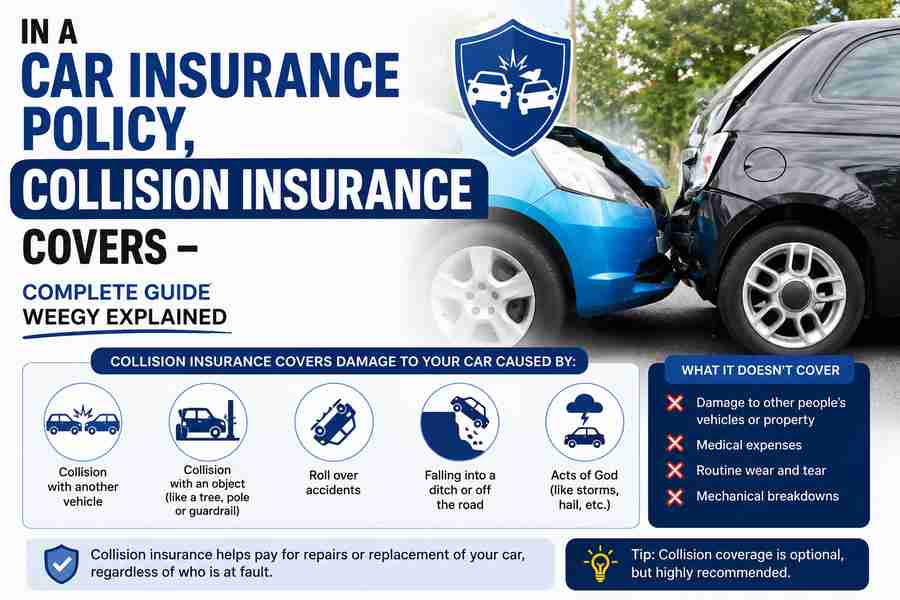
In a car insurance policy, collision insurance covers damage to your vehicle caused by a collision with another vehicle or object.
That’s the short answer. Now let’s explore the details.
What Does Collision Insurance Cover?
Collision insurance applies when your vehicle is damaged due to physical impact. Below are the most common situations it covers:
1. Collision With Another Vehicle
If you hit another car — or another car hits you — collision insurance covers repairs to your own vehicle.
Example:
-
You rear-end another driver at a traffic light.
-
Even if the accident is your fault, collision coverage pays for your vehicle damage.
2. Collision With a Stationary Objec
Collision insurance also covers impact with objects such as:
-
Trees
-
Guardrails
-
Poles
-
Walls
-
Fences
-
Mailboxes
Example:
-
You lose control during rain and hit a tree.
-
Collision insurance covers the repair costs.
3. Single-Car Accidents
If you are the only vehicle involved, collision coverage still applies.
Example:
-
You slide on ice and crash into a ditch.
-
You accidentally hit your garage door.
-
You flip your vehicle.
4. Pothole Damage (In Some Cases)
Hitting a large pothole that damages your suspension or wheel may fall under collision coverage because it involves impact.
What Does Collision Insurance NOT Cover?
Collision insurance is often confused with comprehensive coverage. However, it does not cover non-collision-related damage.
Here’s what it typically does NOT cover:
1. Theft
If your car is stolen, that’s covered under comprehensive insurance — not collision.
2. Natural Disasters
Damage caused by:
-
Flood
-
Hurricane
-
Earthquake
-
Hailstorm
These fall under comprehensive coverage.
3. Vandalism
If someone scratches or damages your car intentionally, collision does not apply.
4. Animal Collisions
Collision Insurance vs. Liability Insurance
Many drivers confuse these two coverages.
Liability Insurance
-
Covers damage you cause to others.
-
Required by law in most states.
-
Does NOT pay for your own car repairs.
Collision Insurance
-
Covers damage to your own vehicle.
-
Optional in most states.
-
Required if your car is financed or leased.
How Collision Insurance Deductibles Work
A deductible is the amount you pay out of pocket before insurance pays the rest.
Common deductible amounts:
-
$250
-
$500
-
$1,000
-
$1,500
Example
Accident repair cost: $4,000
Your deductible: $500
Insurance pays: $3,500
You pay: $500
Higher deductible = Lower premium
Lower deductible = Higher premium
When Is Collision Insurance Required?
Collision coverage is not required by state law in most places. However, it becomes mandatory if:
-
You finance your vehicle
-
You lease your vehicle
-
Your lender requires it
Lenders want protection for the vehicle because they technically own it until it is paid off.
Is Collision Insurance Worth It?
This depends on your vehicle’s value and financial situation.
It May Be Worth It If:
-
Your car is new or expensive.
-
You cannot afford repair costs.
-
You still owe money on the vehicle.
-
Your vehicle’s market value is high.
It May Not Be Worth It If:
-
Your car is old and low-value.
-
The premium exceeds the car’s value over time.
-
You can afford repairs out-of-pocket.
How Much Does Collision Insurance Cost?
The cost varies based on:
-
Your driving history
-
Vehicle value
-
Location
-
Age
-
Deductible amount
-
Credit score (in some states)
On average, collision coverage can add several hundred dollars per year to your premium.
Real-Life Collision Claim Example
Let’s look at a real-world scenario:
Scenario:
You are driving in heavy rain. You hydroplane and hit a guardrail.
Damage cost: $6,000
Deductible: $1,000
Insurance payout: $5,000
You pay: $1,000
If the car is declared a total loss, the insurer pays the vehicle’s actual cash value (ACV) minus your deductible.
What Happens If You’re Not At Fault?
If another driver caused the accident:
-
Their liability insurance should pay for your repairs.
-
You can use your collision coverage first for faster repairs.
-
Your insurer may recover costs later (subrogation).
Does Collision Insurance Cover Rental Cars?
Usually, collision insurance applies to your own insured vehicle.
For rental cars:
-
Your personal policy may extend coverage.
-
You can buy rental company collision damage waiver (CDW).
Always check your policy details.
Collision Insurance and Total Loss
If repair costs exceed the car’s value:
-
The vehicle is declared “totaled.”
-
Insurance pays the market value.
-
Deductible still applies.
If you owe more than the car’s value, you may need gap insurance.
Common Myths About Collision Insurance
Myth 1: It Covers Everything
False. It only covers collision-related damage.
Myth 2: It’s Mandatory Everywhere
False. It’s optional unless required by a lender.
Myth 3: It Covers Medical Bills
False. Medical bills are covered by:
-
Personal Injury Protection (PIP)
-
Medical Payments Coverage
How to File a Collision Insurance Claim
Here’s the typical process:
-
Ensure safety.
-
Call police (if required).
-
Take photos of damage.
-
Contact your insurer.
-
Provide claim details.
-
Get damage estimate.
-
Pay deductible.
-
Vehicle repair or payout.
How to Save Money on Collision Insurance
You can reduce costs by:
-
Increasing deductible
-
Maintaining a clean driving record
-
Bundling home and auto insurance
-
Shopping around for quotes
-
Dropping coverage on older vehicles
Frequently Asked Questions (FAQ)
What is the difference between collision and full coverage?
“Full coverage” usually includes:
-
Liability
-
Collision
-
Comprehensive
Collision alone does not equal full coverage.
Does collision insurance cover engine failure?
No. Mechanical breakdown is not covered.
Does collision insurance cover hit-and-run?
Yes, if your car was hit by another vehicle and the driver left, collision coverage can apply.
Is collision insurance required for older cars?
No. It’s optional unless required by a lender.
Final Answer to the Original Question
In a car insurance policy, collision insurance covers damage to your vehicle caused by a collision with another vehicle or object, regardless of fault.
It protects your car — not the other driver’s car — and applies in crashes involving vehicles, poles, trees, guardrails, and similar impact situations.
Conclusion
Collision insurance is a crucial part of auto insurance protection. While not legally required in most states, it provides financial security against costly vehicle repairs caused by accidents.
Understanding what collision insurance covers — and what it doesn’t — helps you make smarter insurance decisions, avoid unnecessary costs, and ensure proper protection.
Before purchasing or removing collision coverage, evaluate:
-
Your car’s value
-
Your financial stability
-
Loan or lease requirements
-
Risk tolerance
Making the right choice today could save you thousands tomorrow.

- Small Business Finance: Manage Money & Grow Your Business
-
 Health - 02:52:34pm 30-09-2026

- Business Finance Strategies Every Entrepreneur Should Know
-
Health - 02:44:54pm 30-09-2026
-
 Universal
Should I Hire a Lawyer for a Minor Car Accident A Complete Guide to Protecting Your Rights
Universal
Should I Hire a Lawyer for a Minor Car Accident A Complete Guide to Protecting Your Rights
-
 Universal
History of Tangail Zilla in Bangladesh: Ancient Past, British Era, Zamindar Heritage, and Modern Development
Universal
History of Tangail Zilla in Bangladesh: Ancient Past, British Era, Zamindar Heritage, and Modern Development
-
 Universal
The Coverage Included in an Automobile Insurance Policy Weegy A Complete Guide for Drivers
Universal
The Coverage Included in an Automobile Insurance Policy Weegy A Complete Guide for Drivers
-
Business finance
Small Business Finance: Manage Money & Grow Your Business
-
 Technology
Top Technology Trends to Watch in 2026
Technology
Top Technology Trends to Watch in 2026